Thursday, July 11, 2013

Budget Deficit

What is Budget Deficit?

It is a financial situation that occurs when an entity has more money flowing out than coming in, also known as government spending exceeds income. 


Government budget deficit is also known as negative balance. The term “Benefit Deficit” is most commonly used to refer to government spending rather than business or individual spending.


When it refers to federal government spending, a budget deficit is also known as “national debts.” The government budget balance, public budget balance, or public fiscal balance, is the overall result of a country’s general government budget over the course of an accounting period, usually one year. It includes all government levels (from national to local) and public social security funds. 

The budget balance is the difference between government revenues and spending. 

What if the government doesn't control their spending?

They will keep using the money, thus will over spend their money.

Which results in not enough money to cover and use for the next few year. For example, Japan is good at planning their yearly expenses and the country is able to avoid over spending. 

If a government is unable to solve the problem, it is because of over spending, they need to borrow the money from either within their country or outside their country, this will cause country owe more money than the past. 

If government borrow money with others it becomes a debt or liability known as “national debts”. If government doesn't have enough money to pay, budget per year will deficit.

How does a government finance its budget deficit?

Government budget deficits can be financed by two ways:

i. External borrowing - Take loan from other countries.

ii. Internal borrowing - Issue bonds to the public or use their revenue to sell to the foreign exchange reserves.

Either cutting spending, raising taxes or a combination of the two. Deficits must be financed by borrowing money. Interest must be paid on borrowed funds, which worsens the deficit.


Written by: Wong Yaw Li 0310539

Aggregate Demand

What is aggregate demand?

Aggregate demand is the desire to purchase at each possible price level. Simply means spending that includes nation’s households, businesses, and government for purchasing goods and services or investment. However, the biggest issue of businesses is a lack of consumer demand.


The real wealth effect

Consumer wealth could affect the spending because people will spend a percentage of their increased wealth. For example, an unforeseen increase in the stock market prompts consumer to save less and buy more out of their current incomes than they had planned before. As the consumer spending had increased, it will shift the aggregate demand curve rightward.


When consumers start to spend more but doesn't have much cash in hand, they will go for borrowing. This will shift the aggregate demand curve to the right as the consumer consumption is still increasing. But somehow if consumers increase their saving to pay off their debt crisis it will shift the aggregate demand curve leftward. It is because more money flowing to the debt repayment.


In my opinion, we should focus on raising the aggregate demand with employing workers or undertaking public works projects. Lack of aggregate demand or insufficient spending and investment could become a disease for businesses.


Written by: Lin Chui See 0310308

McDonald's and Oligopoly

What is Oligopoly?


  • A market condition in which sellers are so few that the actions of any one of them will materially affect price and have a measurable impact on competitors.


An oligopoly can only exist when a few firms are dominating the industry and have the ability to set prices. McDonald’s is not considered a monopoly since it is not a single seller of a good or one that is unique, that McDonald’s is one of the leading companies in the fast food industry, both in the U.S and internationally.

McDonald's bases its pricing on its rivals' prices.

Barriers of Entry

George Stirgler defined an entry barrier as "A cost of producing which must be borne by a firm which seeks to enter an industry but is not borne by firms already in the industry". 

Economies of Scale: They prevent the entries of newer businesses into the industry. McDonald’s aimed to create long run profit. The size of its firm is increasing and its operations when McDonald’s long run average total cost is declining. For example people are buying franchises, they are expanding their size of their firm while decreasing their AVERAGE TOTAL COST.

What is the Concentration Ratio?

The fast food industry is currently dominated by the "Big Four" :


The market in fast food industry is fairly concentrated, with 12 restaurants taking 71% of the market. There give a concentration ration of 12:71. Therefore, McDonald’s holds a 22% market share with $30 billion in sales.

Advertising

McDonald’s advertising campaigns and slogans capture market share over these years, with spend the most advertising money of any fast food restaurant in the country. The advertising of McDonald’s delivers the newest information to consumers. These almost manipulate other fast food restaurants.  In addition to the usual media including television, radio, and newspaper ads, even though billboards and signage, sponsors sporting events ranging from Little League to the Olympic Games. 


Also with the current Minion trend,


Source: http://libbyaanoosterr.wikispaces.com/McDonald's+-+An+Oligopoly

Written by: Yong Ye Yee 0308476

Haze Affect Demand and Supply?

Recently, Malaysia and Singapore faced the worst air pollution. Did it affect our economy? 

Yes!

We would've faced a bigger economic impact crisis than 16 years ago. The haze has definitely affected the restaurants and shopping malls’ business since the haze was very serious and everyone was not recommended to go outdoors. It would also create a negative impression and stop the tourist inflows, as tourism make up 6.4 percent of Malaysia’s economy.


Due to the air pollution level increase, people are rushing to buy the haze-related product like face masks, eye drops and air purifiers. Meanwhile, it causes the supply for the product decrease. When the supply decreases, it will cause the price of these product to increase. According to the law of supply, firms will supply more when the price is high. Therefore, the firm will start to produce many of these products.


When the haze was disappearing from the skies of Malaysia and Singapore, the sales have fallen by 50 percent. Many shop stop to import the new stocks. Based on reports, when the haze level was serious, it can sell hundreds of boxes daily, but now it has dropped to 10 to 15 boxes only. When at the height of the haze, many retailers who used to set the price up to RM10 each now dropped to RM 0.50 each.


In conclusion, haze affected the demand and supply of Malaysia and Singapore.

Source: http://www.reuters.com/article/2013/06/24/us-southeastasia-haze-impact-idUSBRE95N0BS20130624?irpc=932


Written by: Jo-Ann Luei Sook Qi 0310206

What do Price Elasticity of Cigarette Demand and the Correlation between Cigarette Consumption and Education Attainment Tell Us?

Higher prices increase costs to consumers and discourage cigarette consumption. As the price of an item increases by a certain percentage, consumption of the item falls. The percentage decline in consumption caused by a percentage increase in price is measured by price elasticity of demand. Price elasticity of demand can help show that some of the decline in cigarette consumption can be explained by higher prices, but most of the decline is attributed to expanding health concerns.


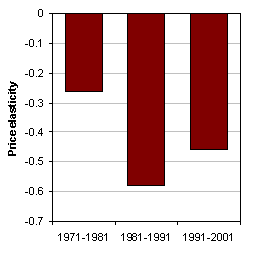
Despite the simplicity of the method used to calculate elasticity of demand in this study (the percentage change in consumption to change in real price), our results closely replicate other empirical studies using different techniques. Our calculations for price elasticity of demand for cigarettes between the years 1971 to 2001 are shown in below.


The price elasticity is -0.26 for the period 1971-81, which indicates that a 10% increase in cigarette price brings a 2.6% decrease in cigarette consumption. The role of cigarette price in determining cigarette consumption increased materially in the 1980s, with a 5.8% reduction in consumption associated with a 10% increase in price. However, over the last three decades, cigarette consumption has remained price inelastic, which means a change in price has a relatively modest downward impact on consumption. Smoking has a major role in contributing to the change in consumers' desire for cigarettes.


Written by: Yap Kien Wai 0309031